Lotte
“Lotte, a gentleman's dressing chest, was one
of three pieces built for a wealthy financier -
is there any other sort? - at the behest of his
wife, who organised his life. For this piece, all
she told me was, 'Steven is quite
conservative' - that was the brief! So I took
command because you have to in a situation
like that.
“From the point of view of function, a
dressing chest calls for drawers and galleried
shelves for all those socks, and bow ties, and
what have you. Designwise, this piece needed
to be severe, simple, and luxurious - it was
going into a Regency house in Kensington,
after all. I imagined one smooth elliptical
casing on a plinth. The timber? Well,
something conservative obviously, but also
remarkable. Call to veneer merchant: 'Hello,
what have you got?' Exotic Veneers
suggested a Siberian walnut burr that it
called 'Kashmir'. I went to have a look.
Brilliant! The leaves, which were large and
perfect, and as a four-cut match were about
right for the casing, which would open to
reveal an interior finished in plain-sawn
sycamore, and all based on a substrate of
Latvian birch. The finishing touches would
come from French walnut cross-banding,
rosewood drawer knobs, and silver nickel
gallery rails.
“Construction began by chalking an
ellipse on the workshop floor, 1000mm on
the major axis, 666mm on the minor; the
cabinet was to be 1150mm high. Actually
building Lotte was very, very difficult
because all the components then had to be
reduced from the master pattern, which
called for some extremely accurate setting
out and router work.
“The piece took three months to build, and
I called her Lotte because pieces of this calibre
take on a persona of their own, and naming
somehow draws you closer to them.”
Moonbase One
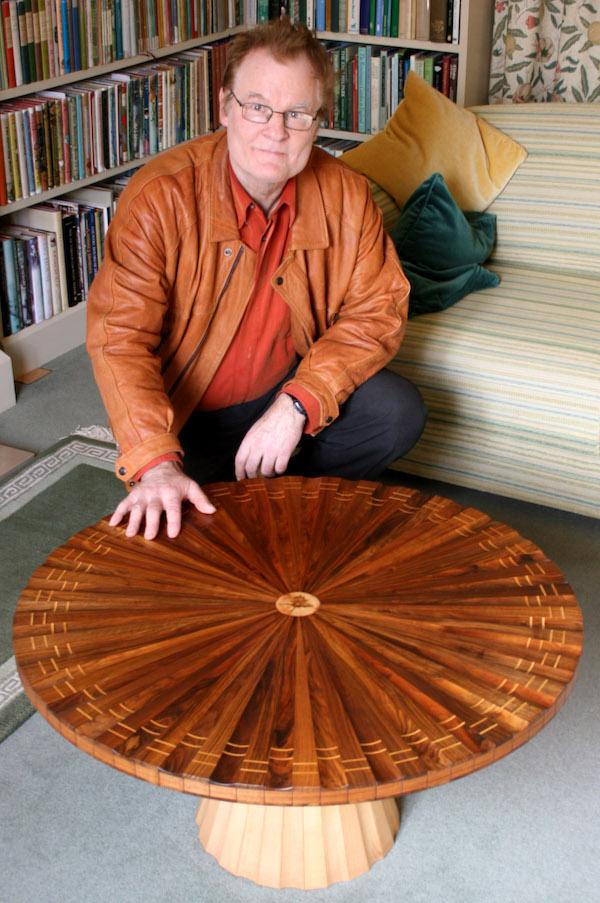
Moonbase One “This piece was made for a gentleman who lived in a small stone
cottage. He wanted a coffee table. There wasn't a brief, and I didn't
tell him what I was going to do. Sometimes, you see, you can use a
client's request as an excuse to engage in what I call 'pondering'.
“What is a table?” I asked myself. A platform on legs. And what can a
table look like? It's that world of 'if', again. The commission, then,
became an exercise in experimenting with the ways that a table can
'be'. A marriage, perhaps, of fat and thin, square and round?
“When pondering, I tend to look into blackness and bombard the
blackness with shapes. Squashed pumpkins for legs; for the top a kind
of thin biscuit. And that's how Moonbase One came about. Suddenly, I
was looking at this object floating in the blackness like a space
platform waiting for something to land on it.
“The table top itself was made from plain-sawn sycamore framed
with wild English field maple. The legs were made from laminated
sycamore, and the shape of the connecting reducing collars was
influenced by the insulators on electric pylons.”
Bertie
Bertie “With most of my special pieces, I demand
carte blanche. Otherwise, I've found that I
suffer unwelcome interference from the
client. However, in the case of Bertie here,
who was commissioned by a futures dealer,
the brief was for anything, 'as long as we can
play backgammon on it.' So, a backgammon
table it was! The top, I decided, would
unfold, swivel 90°, and lock in the playing
position. Its frame would be made of walnut
with a border and darts of African black
walnut and wild English field maple laid into
a floor of bubinga.
“For the rest, clean, simple lines were the
order of the day: swept legs and grain all
running the same way would do away with
shoulder lines and make the table appear all
of a piece, and give Bertie 'stance', or
animation if you like.
“David Roberts turned the barrel drawers,
shakers and pieces, African black walnut one
end, maple the other; the drawer knobs
were styled on a shirt collar stud!”

▲ Line and form inspired by ancient
Egypt give these pieces real presence
Egyptian Suite
“I was first invited to Belgravia to meet
Robin, a collector of Beidermeier furniture,
to discuss making a desk in the same style
because she couldn't find one to buy. As
chance would have it, however, by the time
of the appointment she'd managed to
purchase a desk. Instead, I was shown up to
the master bedroom and told, 'We could do
something in here.' In the style of
Beidermeier? I asked. “Not necessarily,' was
the reply. 'What would you suggest?' Music
to my ears! I looked around to read the tea
leaves: everything was expensive and
immaculate. I'll have to think about it, was
all I could say. 'Good. Let me know when
you have.' End of interview.
“Well, I certainly thought about it. In fact, I
wracked my brains. Some Beidermeier points
to Neo-Classicism, and Neo-Classicism points
towards Egypt - well, most things do. What if
I donned the mantle of Beidermeier and
thought about Egyptian line and form? What
you see here is an ode to that frame of mind.
“Setting out the cabinets was riveting,
agonising over line and form, guessing what
the Golden Mean would reveal. These
cabinets have presence, and it wasn't easy
achieving it.
“They're made from bar ripple sycamore,
both solid and veneer, with American
walnut inlay. The doors are fitted with
touch latches, and open to reveal the
inner casings, fitted out with
compartmentalised drawers and roll-out
shelves. Creating those coved tops on
the spindle moulder was a terrifying
experience, with the sycamore
threatening to tear out at every pass.”
The Cockpit Kitchen
“This commission, for a kitchen that would
be part of a converted barn, came via an
architectural practise that had, 'a wealthy
client who was as mad as a rat and couldn't
decide what she wanted except that it had to
be modern.' I submitted two designs, which
were rejected ('Love 'em, couldn't live with
them,' she said). I declined to submit any
more designs, and asked to meet the client,
with whom I got on like a house on fire.
Mercurial by nature but full of fun and wit,
she'd become bored by the pedestrian
attitude of the architect.
“I toyed with the idea of the kitchen being
circular, but as to the style, well… It was to
be part of an old stone barn, so there seemed
little hope of modernity, which can in any
case be antiseptic. Better, I decided, to go
down the charm route but keep it simple. So
I drafted an idea, but didn't give too much
away - clients are rarely able to understand
or visualise two dimensional drawings - and
without much ado she said, 'OK.'
“I was in seventh heaven, and simply got
on with all I'd imagined. Again, the cabinets
were built on a carcase of Latvian birch ply
and finished with plain-sawn sycamore,
with ebony detailing and ebonised handles.
“As always with clients, I let her come at a
pre-arranged time to view progress. However,
I received no reply to my invitations, and
eventually learned from the architect that
she was at her studio in Umbria. Now I was
worried. This was someone who could easily
say, 'Don't like that, change it,' but I was
already over halfway through the job. What
to do? Hold my breath and carry on? In the
end, that was exactly what I did.
“When she returned some weeks later, the
kitchen was almost complete. I 'phoned.
'Wonderful,' she said. 'Can't wait to see it.'
At the time, my workshop was very long, and
on entering it you could see everything.
What if she walked in, took a look and
rejected it? Worry turned to paranoia. Then I
had an idea. The kitchen had been built
almost to entirety on a deck at the far end of
the workshop from the door, so I built a wall
from 8 x 4ft sheets of ply with an offset
entrance so that nothing was visible from the
door. The surprise was set! As an afterthought,
I bought a decent bottle of Madeira.
“She arrived, all smiles, kisses and
apologies. I could see she was puzzled:
'Where's the kitchen?' I pointed to the false
wall and she disappeared through the door. I
remember looking upwards and praying,
'Please let it be alright.' Then I heard a little
whoop and she was out telling me that she
loved it. I could've fainted with relief! Out
came the Madeira and while I gave her a
guided tour of the work we swigged the stuff
from tumblers. The bottle didn't last very
long and we became quite daft, laughing
drunkenly about the chancer I'd taken.
“The moral? Courage mon brave. When
you're out on a limb, don't look down!”